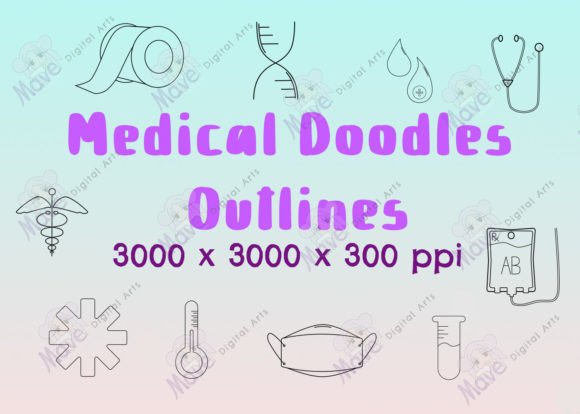
Medical Doodle Outlines Illustration
A Designer’s First Look: Charm Without Clutter
Opening Medical Doodle Outlines Illustration, I immediately felt that rare balance—playful but purposeful. These aren’t clinical icons or stiff vector clipart; they’re hand-drawn-style outlines with gentle curves, light asymmetry, and breathing room around every shape. Think stethoscopes with soft loops, heart icons with a slight tilt, syringes drawn with expressive line weight—not rigid geometry. The 21 illustrations share a cohesive visual language: consistent stroke thickness, open negative space, and zero internal detail that would vanish under thread. That’s not an accident—it’s smart design thinking for embroidery.
Real Project Test: A Nurse-Themed Embroidered Tote Bag
Last week, I prepped a custom order for a pediatric nurse: a cotton canvas tote bag with “Strong Hands, Gentle Heart” stitched on the front—and a small, centered Medical Doodle Outlines Illustration (the heart + stethoscope combo) just below the text. Why this set? Because it scaled cleanly to 3.2 inches wide without losing definition, held up beautifully in satin stitch along the outer lines, and left enough open fabric to let the cotton texture show through. Customers notice that subtlety—the handmade product feels intentional, not mass-produced. No one mistook it for a generic stock graphic.
Where It Shines—And Where It Needs Care
Medical Doodle Outlines Illustration works exceptionally well for:
- Custom apparel: Sweatshirt embroidery on midweight fleece—clean edges, no bleeding or puffing when paired with medium-weight cutaway stabilizer.
- Baby embroidery: On organic cotton onesies, the open-line style avoids dense fill stitches that could irritate sensitive skin.
- Embroidered patch: Perfect for iron-on or sew-on patches—simple shapes translate reliably across backing types and border stitching.
- Holiday embroidery: Paired with red-and-cream thread on tea towels, it reads warmly—friendly, not sterile.
- Etsy seller assets: As design assets, these outline illustrations lend themselves to printable mockups and layered digital previews without overwhelming the composition.
But be thoughtful in these situations:
- Small hoop sizes (<4" diameter): Some of the more intricate doodles—like the detailed anatomy heart—lose clarity if shrunk below 2.5". Stick to the simpler silhouettes (cross, heartbeat line, pill bottle) for tiny placements like cap brims or baby socks.
- Textured or stretchy fabric: On terry cloth towels or jersey knit tees, test stitch density first. Overly tight running stitch along thin outline paths can pucker. A light tear-away stabilizer helps—but don’t skip the scrap test.
- Dark fabric: These are outlines, so contrast matters. Navy or charcoal needs crisp white, ecru, or metallic thread—not off-white or heather gray. Always check black-and-white mockups before finalizing.
- Curved surfaces: Caps and curved pillow covers require careful digitizing adjustment. The original Medical Doodle Outlines Illustration files will need minor path smoothing for smooth flow over domes and seams.
What This Design Says About Your Brand—Before a Single Stitch
Using Medical Doodle Outlines Illustration signals care—not just in theme, but in execution. It doesn’t shout. It invites. That quiet confidence builds customer trust, especially for personalized gifts or boutique branding. A new mom buying a nursery-themed pillow cover doesn’t want medical jargon or harsh realism—she wants warmth, humanity, and craft integrity. This set delivers that tone without leaning into cliché.
For Etsy sellers and small shop owners, it elevates perceived value. Compare it to dense, over-digitized clipart: customers scroll past clutter. They pause at simplicity done well. And because the outlines leave space for customization—adding names, dates, or complementary motifs—you’re not locked into a single look. That flexibility strengthens brand consistency across your craft business.
Practical Notes Every Embroidery Designer Should Check
Before cutting fabric or loading your machine embroidery design:
- Test on scrap fabric first—especially if pairing with applique design elements or layered fill stitches.
- Review stitch density: Outline-only files tend to run lighter, but verify no sections demand excessive travel stitches or tiny jump points.
- Confirm hoop size compatibility: Not all 21 illustrations fit comfortably in a 4×4 hoop at recommended scale—measure key dimensions before batch digitizing.
- Inspect small details: The syringe plunger and EKG line endpoints should be clean, not jagged or pixelated—even in high-resolution illustrations, vector fidelity varies.
- Compare light and dark fabric backgrounds in your design software. What reads as delicate on white may disappear on black without thread color adjustment.
- Use proper stabilizer: Medium cutaway for knits, lightweight tear-away for stable wovens. Skip fusible web unless you’re making an embroidered patch meant for iron-on application.
- Confirm licensing before selling finished products or bundling as digital embroidery file packs. Since Medical Doodle Outlines Illustration is categorized as Graphics, review usage rights carefully—commercial embroidery and resale of physical goods often require extended licenses.
Final Thought: Simplicity With Substance
There’s a quiet power in restraint. Medical Doodle Outlines Illustration doesn’t try to do everything—and that’s its strength. It leaves room for your voice as a designer, your client’s story, and the honest texture of handmade product. Whether you’re stitching a heartfelt holiday embroidery gift, building a cohesive line of nurse-themed apparel, or creating digital product previews for your Etsy shop, this set supports intention—not decoration. It’s not just another illustration pack. It’s a thoughtful starting point—one that respects both the craft and the person wearing or gifting the finished product.